Why PIPEDA Matters for Every Link You Shorten
Every time someone clicks a shortened link, data is collected: IP addresses, device types, browsers, geographic locations, and referral sources. For Canadian businesses, this data collection is governed by PIPEDA — the Personal Information Protection and Electronic Documents Act.
If you're using a link shortener like Bitly, TinyURL, or Rebrandly, there's a good chance your click data is being stored on US servers, outside the reach of Canadian privacy law. This isn't just a theoretical risk — it's a compliance gap that could expose your organization to penalties under PIPEDA.
This guide provides a practical checklist for evaluating whether your link shortening and analytics tools meet Canadian privacy requirements.
What PIPEDA Requires for Click Data
PIPEDA applies to any organization that collects, uses, or discloses personal information in the course of commercial activity. Click data from shortened links qualifies because it can include:
- IP addresses — considered personal information under PIPEDA
- Geographic location — derived from IP, can identify individuals in small communities
- Device and browser fingerprints — can be used to track individuals across sessions
- Referral sources — reveals browsing behavior and interests
- Click timestamps — combined with other data, creates behavioral profiles
The Office of the Privacy Commissioner of Canada (OPC) has confirmed that IP addresses are personal information when they can be associated with an identifiable individual — which is the case for most link analytics platforms.
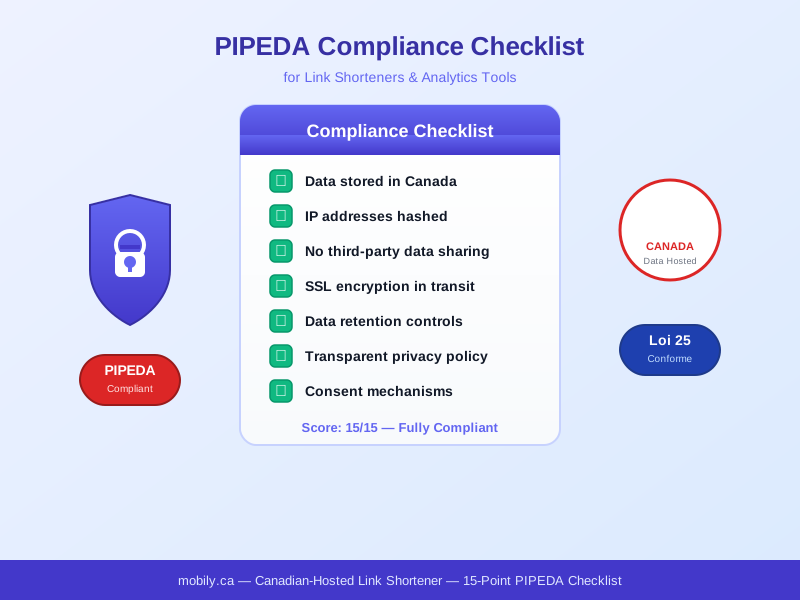
The PIPEDA Compliance Checklist
Use this checklist to evaluate your current link shortener and analytics tools. Each item maps to a specific PIPEDA principle.
1. Data Residency — Where Is Your Data Stored?
PIPEDA Principle: Accountability (Principle 1) — Organizations are responsible for personal information under their control, including data transferred to third parties.
- Check: Is click data stored on Canadian servers?
- Check: Does your provider have a Canadian data residency option?
- Red flag: Data stored in the US is subject to the CLOUD Act, which allows US authorities to access it without notifying Canadian data subjects
How the major link shorteners compare:
| Service | Data Location | Canadian Hosting |
|---|---|---|
| Mobily | Canada (AWS ca-central-1) | Yes |
| Bitly | United States | No |
| TinyURL | United States | No |
| Rebrandly | United States / EU | No |
| Short.io | United States | No |
2. IP Address Handling — Is PII Being Protected?
PIPEDA Principle: Safeguards (Principle 7) — Personal information must be protected by security safeguards appropriate to the sensitivity of the information.
- Check: Are IP addresses hashed or anonymized before storage?
- Check: Can individual visitors be re-identified from stored data?
- Red flag: Storing raw IP addresses without anonymization exceeds what is necessary for analytics purposes
Mobily hashes all IP addresses using a one-way algorithm before storage, making re-identification impossible. Geographic analytics use aggregated data only.
3. Third-Party Data Sharing — Who Else Gets Your Data?
PIPEDA Principle: Limiting Use, Disclosure, and Retention (Principle 5) — Personal information shall not be used or disclosed for purposes other than those for which it was collected.
- Check: Does your link shortener sell data to advertisers?
- Check: Is click data shared with third-party analytics platforms?
- Check: Does the privacy policy clearly state data sharing practices?
4. Consent and Transparency
PIPEDA Principle: Consent (Principle 3) — Knowledge and consent are required for the collection, use, or disclosure of personal information.
- Check: Does your link shortener have a clear, accessible privacy policy?
- Check: Are users informed about what data is collected when they click a link?
- Check: Is implied consent sufficient for your use case, or do you need express consent?
5. Data Retention and Deletion
PIPEDA Principle: Limiting Retention (Principle 5.3) — Personal information shall be retained only as long as necessary for the fulfilment of those purposes.
- Check: Does your provider have a data retention policy?
- Check: Can you delete click data on request?
- Check: Is old data automatically purged?
Mobily retains click analytics for up to 365 days (depending on plan), then automatically purges old data. Account deletion removes all associated data permanently.
6. Encryption and Security
- Check: Is all traffic encrypted with SSL/TLS?
- Check: Is data encrypted at rest?
- Check: Does the provider have SOC 2 or equivalent certification?
Quick Compliance Score
Count how many of the 18 checks above your current link shortener passes:
| Score | Assessment | Action |
|---|---|---|
| 13-15 | Fully compliant | Maintain current practices |
| 9-12 | Partially compliant | Address data residency and IP handling gaps |
| 5-8 | Significant gaps | Consider switching to a Canadian-hosted provider |
| 0-4 | Non-compliant | Immediate action required — switch providers |
How Mobily Handles PIPEDA Compliance
Mobily was built from the ground up for Canadian privacy compliance. Here's how each PIPEDA principle is addressed:
- Data residency: All servers in Canada (AWS ca-central-1 region)
- IP anonymization: One-way hashing before storage — re-identification impossible
- No data selling: Click data is never shared with or sold to third parties
- Transparent privacy policy: Read our full privacy policy
- Data retention controls: Automatic purge based on plan (30-365 days)
- SSL encryption: All traffic encrypted in transit, data encrypted at rest
- Account deletion: Full data removal on account closure
What About Provincial Privacy Laws?
In addition to PIPEDA, three provinces have their own substantially similar privacy legislation:
- Quebec: Law 25 (formerly Bill 64) — stricter than PIPEDA, requires privacy impact assessments and explicit consent for certain data uses
- Alberta: PIPA — Personal Information Protection Act
- British Columbia: PIPA — Personal Information Protection Act
Organizations operating in these provinces must comply with both PIPEDA and the applicable provincial law. Using a Canadian-hosted link shortener like Mobily simplifies compliance across all jurisdictions.
PIPEDA Compliance Timeline for New Businesses
If you are launching a Canadian business or startup that uses link shorteners and analytics tools, here is a practical compliance timeline:
Before Launch (Day 0)
- Choose a Canadian-hosted link shortener (avoid US-based services)
- Draft your privacy policy covering all data collection points
- Implement cookie consent banner if using any tracking
- Set up data retention schedules (how long you keep click data)
First 30 Days
- Conduct a data inventory — document every tool that touches personal information
- Verify all third-party services store data in Canada (or have adequate privacy protections)
- Train team members on data handling procedures
- Test your data deletion process end-to-end
Quarterly Ongoing
- Review analytics tools for new data collection features that may require updated consent
- Audit third-party integrations (did any change their data storage location?)
- Update privacy policy if you added new features or tracking
- Review and purge data that has exceeded its retention period
Common PIPEDA Violations with Link Shorteners
The Office of the Privacy Commissioner of Canada (OPC) has identified these as common compliance gaps that link analytics tools can create:
- Collecting without consent: Using link tracking that captures IP addresses without disclosing this in your privacy policy
- Excessive data retention: Keeping click analytics data indefinitely when it is only needed for campaign reporting
- Cross-border transfer without notice: Using a US-based shortener without informing users that their data leaves Canada
- Inadequate security: Sharing analytics dashboards through unencrypted links or weak passwords
- No breach response plan: Having no documented process for what happens if your link analytics data is exposed
Each of these violations can result in OPC investigations, public findings, and compliance orders. For businesses in regulated industries, the reputational damage alone can be significant.
Conclusion: Choose Your Tools Carefully
For Canadian businesses, the choice of link shortener has real privacy implications. A tool that stores click data in the US creates a compliance gap that can't be papered over with contractual clauses — once data is on US servers, the CLOUD Act applies regardless of your agreement with the provider.
The simplest way to ensure PIPEDA compliance for your link tracking is to use a provider that keeps your data in Canada. Start with Mobily's free plan — 50 links, full analytics, Canadian-hosted, no credit card required.
Free PIPEDA Compliance Check
Not sure if your current link shortener is PIPEDA compliant? Switch to Mobily and eliminate the guesswork — all data stays in Canada, always.
Start Free — 50 Links, No Card Required