Most small businesses reach for a URL shortener the same way they reach for a stapler — grab what is nearby, do not think about it too hard. Bitly is the household name, so Bitly it is. The problem is that Bitly, like almost every major link shortener, was built for US audiences, stores data on US servers, and operates under US law.
For a Canadian small business, that matters in ways that are not obvious until you need them to be.
The Data Sovereignty Problem
Every time someone clicks a link you have shortened, data is generated: their IP address, location, browser, device type, the time of the click, and the referrer. That data is personal information under Canada's Personal Information Protection and Electronic Documents Act (PIPEDA).
When your link shortener stores that data on American servers, two things happen simultaneously. First, that data becomes subject to US law — including the CLOUD Act, which allows US authorities to compel American companies to hand over data about anyone, including Canadians, stored anywhere in the world. Second, your organization becomes accountable under PIPEDA for the data practices of your US vendor, even though you have no practical control over them.
This is not a hypothetical compliance risk reserved for large enterprises. PIPEDA applies to any organization engaged in commercial activity in Canada, regardless of size. A ten-person marketing agency sending email campaigns with shortened links is subject to the same accountability principles as a bank.
Choosing a Canadian-hosted shortener sidesteps the cross-border transfer problem entirely. Data stays in Canada, governed by Canadian law, with a vendor your own privacy policy can accurately describe.
CAD Pricing and Canadian Contracts
There is a less-discussed practical benefit to choosing a Canadian provider: billing in Canadian dollars. Most US SaaS tools charge in USD, which means your monthly cost fluctuates with the exchange rate. At the time of writing, USD pricing means paying roughly 35–40% more in actual CAD than the listed price suggests.
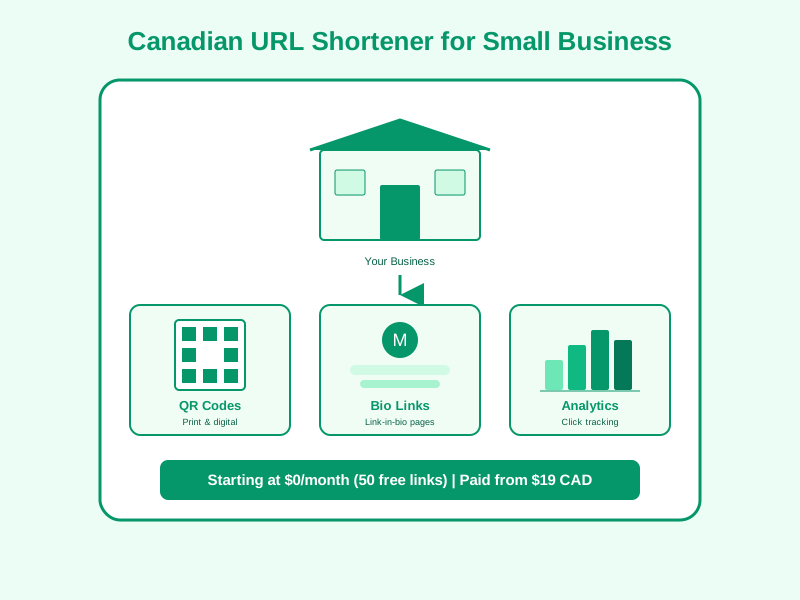
Mobily charges in CAD. The Starter plan is $19 CAD per month — what you see is what you pay, with no currency conversion surprises on your credit card statement. For small businesses managing tight margins, predictable CAD pricing is a genuine operational benefit, not just a marketing talking point.
Bottom Line:
When your link shortener is billed in CAD and hosted in Canada, you avoid currency conversion surprises and PIPEDA compliance ambiguity in one move.
Features That Actually Matter for Small Businesses
Enterprise link shortener features — API rate limits in the millions, SSO integrations, white-glove onboarding — are irrelevant noise for most small businesses. Here is what actually matters at the small business scale, and how a Canadian shortener addresses each.
QR Code Generation
Print is not dead for small businesses. Business cards, flyers, restaurant menus, event signage, and product packaging all benefit from QR codes that link to your website, booking page, or social profiles. Generating those QR codes should not require a separate tool.
Mobily's free QR code generator is built directly into the platform. Create a shortened link and generate a QR code for it in the same workflow, with download options suitable for print resolution. If you update the destination URL later, links using your custom domain update automatically — the printed QR code stays valid.
Bio Link Pages
Instagram, TikTok, and LinkedIn each allow one URL in a profile bio. For small businesses managing multiple destinations — website, booking page, product catalogue, current promotion — a bio link page aggregates all of them behind a single URL.
Mobily's bio link pages are included on paid plans and take minutes to set up. Unlike third-party bio link tools that introduce another vendor's data practices into your stack, your bio link data stays on the same Canadian-hosted platform as your shortened links.
Click Analytics Without Surveillance
Small businesses do not need heatmaps and cohort analysis. They need to know: which links are getting clicks, from where, on what device, and at what time. Mobily's analytics provide exactly that — province-level geographic breakdown, device type, referrer source, and click timeline — without storing raw IP addresses or selling that data to third-party ad networks.
This lets you answer real business questions (did the email campaign drive traffic? which social platform sends the most clicks?) without the overhead of an analytics platform designed for enterprise marketing teams.
Custom Domains
A shortened link under your own domain (e.g., go.yourbusiness.ca) looks more professional in email and print than a generic shortener domain, and it reinforces brand recognition at every touchpoint. Custom domains are available on Mobily's paid plans and take about fifteen minutes to configure with your domain registrar.
Feature Comparison: What Small Businesses Actually Need
When evaluating link shorteners, filter the feature list down to what your business will actually use in the next twelve months:
- Shortened links with click tracking — universal, every shortener covers this
- QR code generation — built into Mobily; separate tool required for most US competitors
- Bio link pages — built into Mobily; separate subscription for Linktree or similar
- Custom domain — available on Mobily paid plans; often locked to higher tiers elsewhere
- Canadian data residency — Mobily only among consumer-grade shorteners
- CAD pricing — Mobily only
The consolidation argument is straightforward. If you are currently paying separately for a link shortener, a QR code generator, and a bio link tool, switching to a Canadian platform that covers all three saves both money and vendor complexity.
Getting Started in Under Ten Minutes
Getting a Canadian URL shortener running for your small business does not require a migration project. Here is the practical sequence:
Step 1: Create a free account. Mobily's free plan includes 50 links — enough to run a real campaign and evaluate the analytics before spending anything. No credit card required.
Step 2: Shorten your most-used URLs. Start with the links you share most frequently: homepage, booking page, current promotion, social profiles. Give each a descriptive name in Mobily so your analytics dashboard is readable at a glance.
Step 3: Generate QR codes for print materials. For any link that appears on physical materials — business cards, flyers, menus — generate a QR code through Mobily's built-in generator. Download the high-resolution version for your printer or designer.
Step 4: Set up a bio link page. If you use Instagram or TikTok for your business, create a bio link page that aggregates your key destinations. Update it when your promotions change — no need to reprint anything or update your social profile URL.
Step 5: Connect a custom domain (optional). When you are ready to put your brand on your links, connect a custom domain. The setup guide walks through the DNS configuration step by step.
The Right Tool for the Canadian Market
The link shortener market was built for US businesses, with US data practices, US pricing, and US legal frameworks. Canadian small businesses have been accepting that as the default because alternatives were not visible.
Mobily is a Canadian-built, Canadian-hosted shortener with CAD pricing, PIPEDA-conscious data handling, and a feature set sized for small business reality rather than enterprise complexity. The free plan removes the barrier to trying it, and the paid plans are priced at a point that makes sense in CAD without conversion math.
For Canadian small businesses, the question is not whether a Canadian-hosted shortener is better in principle. The question is whether the practical benefits — compliance clarity, CAD pricing, integrated QR codes and bio links — are worth ten minutes to set up an account and find out.
Try Mobily Free — Built for Canadian Business
50 free links, QR codes, bio pages, and analytics. Canadian-hosted, CAD billing, no credit card.
Start Free