How to Write a Canadian Resume That Passes ATS — With AI
Mobily Team
Content Strategist & Link Expert
Most resumes are rejected before a recruiter ever reads them. Applicant tracking systems (ATS) — the software Canadian employers use to filter applications — score resumes against job posting keywords and discard anything below their threshold. A strong resume that is poorly formatted, or one that uses the wrong terminology, never makes it through.
This guide covers what ATS systems look for, how to structure a Canadian resume for maximum compatibility, and how the Mobily AI resume builder automates the hardest parts.
What Is an ATS and Why Does It Matter in Canada?
An applicant tracking system parses your resume into a structured database — work history, education, skills, dates — and scores it against the job description. Canadian employers of all sizes use ATS platforms: federal government departments use PeopleSoft, large enterprises use Workday or Taleo, and mid-sized companies increasingly use Lever or Greenhouse.
The parsing step is where most candidates lose. If your resume is built in a table, uses headers and footers, or has columns that the parser cannot linearise, critical information gets lost. If your skills are listed differently from the job posting — "JS" versus "JavaScript", "data analysis" versus "data analytics" — the keyword match fails.
Getting past ATS is not about gaming the system. It is about communicating clearly in terms the system understands. The sections below lay out exactly how to structure a Canadian ATS resume that clears the filter and compels the recruiter.
The Canadian Resume Standard
Canadian resumes follow a distinct format from US or UK conventions. Key differences:
- No photo, no age, no marital status — including these is considered inappropriate and may signal to Canadian recruiters that the candidate is unfamiliar with local norms. PIPEDA and provincial human rights codes discourage collection of this information.
- Length — one page for early-career candidates, two pages for experienced professionals. Three pages is acceptable only for academic or executive roles. Unlike UK CVs, Canadian resumes are not exhaustive career histories.
- Date format — month and year only (Jan 2022 – Mar 2024). Exact dates are not expected.
- References — do not list references on the resume. "References available upon request" is also unnecessary.
- Bilingual candidates — for federal government positions and many Quebec-based roles, noting language proficiency (English/French) near your contact section is expected. CBC language levels (A, B, C, E, X) are used in federal job competitions.
Resume Sections That ATS Prioritises
Professional Summary
A 3–4 sentence summary at the top of the resume serves two purposes: it gives the ATS a dense concentration of relevant keywords in the first parsing pass, and it gives the recruiter — who may spend 7 seconds on an initial screen — a reason to keep reading.
Weak summary: "Experienced professional looking for new opportunities to grow."
Strong summary: "Results-driven software developer with 6 years of experience building distributed systems for Canadian fintech companies. Delivered three production microservices handling $2M in daily transaction volume. Expert in Go, Kubernetes, and PostgreSQL, with a track record of reducing infrastructure costs by 30%."
The second version contains job-title terms, industry context, quantified achievements, and specific technologies — all ATS-parseable signals.
Work Experience Bullet Points
ATS systems weight recent experience heavily. Each bullet point should follow the CAR structure: Context → Action → Result. Action verbs matter — passive constructions ("was responsible for") score lower than active ones ("led", "delivered", "reduced", "built").
Quantify wherever possible. "Improved performance" is a weak signal. "Reduced API response time by 40%, from 800ms to 480ms median" is specific, credible, and keyword-rich.
Skills Section
List skills explicitly — do not assume the ATS will infer them from context. A well-structured skills section uses categories (Technical Skills, Tools, and Languages) and mirrors the terminology in job postings. If the posting says "React.js", do not list "ReactJS". The match is string-based, not semantic, in most ATS implementations.
Education
List degree, institution, and year of completion. For Canadian professional designations (CPA, P.Eng., PMP, CFA), include them prominently — either after your name in the header or in a dedicated certifications section. Many Canadian ATS configurations specifically filter for these designations in regulated industries.
ATS-Friendly Formatting Rules
- No tables or text boxes — parsers read left to right, top to bottom. Tables break the linear flow.
- No headers or footers — content in these areas is often skipped entirely by PDF parsers.
- Standard section headings — "Work Experience", "Education", "Skills". Creative headings like "My Journey" or "What I Bring" are not recognised by most ATS parsers.
- Readable fonts — Times New Roman, Arial, Calibri, Georgia. Decorative fonts fail OCR-based parsers used by older government systems.
- Submit as PDF or DOCX — PDF is preferred for visual fidelity; DOCX is preferred by older ATS systems. When in doubt, submit both or follow the posting instructions.
- No images, logos, or icons — these are invisible to parsers and waste valuable space.
How the Mobily AI Resume Builder Handles This
Writing a resume to these specifications is time-consuming. The Mobily AI resume builder for Canadian job seekers automates the hardest parts.
AI-Generated Bullet Points
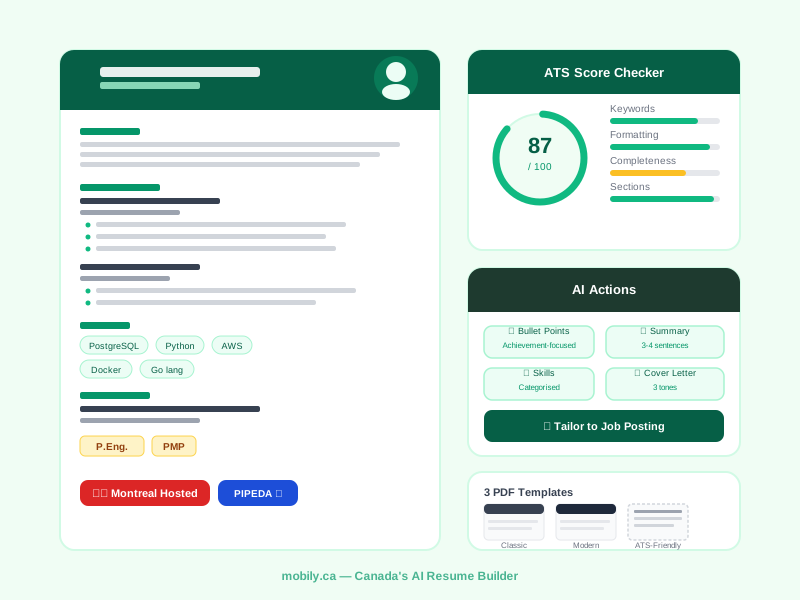
Paste your job title, employer, and a brief description of your responsibilities. The AI rewrites them into achievement-focused, quantified bullet points using strong action verbs — the same structure that ATS systems score highest. The knowledge base it draws from includes Canadian market data, industry achievement patterns, and role-specific terminology.
ATS Score Checker
Paste a job posting and the ATS checker scores your resume against it — keyword match rate, formatting compliance, section completeness — and identifies the specific gaps. Starter plan: 3 checks per day. Pro: 10. Business: 30.
Three ATS-Tested Templates
All three export templates — Classic, Modern, and ATS-Friendly — are structured for parser compatibility: no tables, no text boxes, standard section headings, clean PDF output. The ATS-Friendly template uses Times New Roman and removes all decorative elements for maximum compatibility with older government and enterprise ATS systems.
LinkedIn Import
Download your LinkedIn profile as a PDF (Profile → More → Save to PDF), upload it to the editor, and the parser extracts your work history, education, skills, and contact information. No manual re-entry.
Cover Letter Generation
For each application, generate a tailored cover letter in three tones — professional, enthusiastic, or concise — matched to your resume content and the target role. Export as PDF alongside the resume.
Canadian Hosting and PIPEDA Compliance
All resume data is stored on Canadian servers in Montreal (AWS ca-central-1). Your resume content never leaves Canadian infrastructure — relevant for candidates applying to roles in regulated industries (banking, healthcare, government) where data residency matters.
A Practical Workflow for Your Canadian ATS Resume
- Import your LinkedIn PDF or enter your experience manually.
- Use the AI to rewrite each work experience section into CAR-structured bullet points.
- Generate a professional summary targeted at your next role.
- Paste the job posting into the ATS checker — review the score and fill in missing keywords.
- Use "Job Tailoring" to automatically reorder and re-weight your content for that specific posting.
- Generate a cover letter in whichever tone fits the employer.
- Export as PDF using the ATS-Friendly template if the employer uses a large enterprise or government ATS, or the Classic or Modern template for tech companies and startups.
The full workflow takes 20–30 minutes for a well-documented candidate — compared to 3–4 hours of manual formatting and rewriting.
What the AI Does Not Do
The AI does not fabricate experience or credentials. It improves and restructures the information you provide. Quantification suggestions (percentages, timeframes) are drawn from your inputs — the AI will surface the opportunity but you supply the number. If a metric is not available, the bullet point is written without one rather than inventing one.
The ATS score checker identifies keyword gaps but does not auto-fill them. You decide which terms to incorporate based on your actual experience.
Get Started
The Mobily AI resume builder is available on all paid plans starting at $19 CAD/month. Compare full plan details — every paid tier includes the resume writer, QR codes, bio pages, and link analytics. The Starter plan includes 1 resume, 10 AI generations per day, PDF export, ATS checker (3 checks/day), and 3 cover letters per day — enough for an active job search.