When a Canadian employee clicks a shortened link in your email campaign, a chain of data collection starts immediately: IP address, browser type, device model, geographic location, referrer URL, and timestamp. For most link shorteners, that data lands on servers in the United States, processed by companies subject to US law — not Canadian law.
For businesses operating under Canada's Personal Information Protection and Electronic Documents Act (PIPEDA), this is not a minor technical detail. It is a compliance question.
What PIPEDA Actually Requires
PIPEDA is Canada's federal private-sector privacy law. It governs how organizations collect, use, and disclose personal information in the course of commercial activity. The core principles are consent, purpose limitation, data minimization, and accountability.
Link tracking sits at the intersection of all four. When you shorten a URL and share it publicly or in a marketing email, you are collecting personal information about every person who clicks it — even if you never see their name. IP addresses are considered personal information under PIPEDA because they can reasonably identify an individual.
Three PIPEDA principles are directly relevant to link shorteners:
- Purpose limitation: You must only collect data for purposes a reasonable person would consider appropriate given the circumstances. Collecting IP addresses to track click geography for campaign analytics is generally defensible. Selling that data to third parties or using it for profiling is not.
- Data residency and cross-border transfers: PIPEDA does not prohibit transferring data outside Canada, but it requires that you take contractual or other means to provide comparable protection. In practice, many organizations interpret this as preferring Canadian-hosted solutions to avoid ambiguity.
- Accountability: Your organization is accountable for personal information in the hands of third parties — including your link shortener vendor. If your vendor suffers a breach or sells data, your organization bears accountability to affected individuals.
Key Takeaway:
IP addresses are personal information under PIPEDA. Any tool that collects them on your behalf — including your link shortener — must meet Canadian privacy standards.
Why US-Hosted Shorteners Create Compliance Risk
The dominant link shorteners — Bitly, Rebrandly, TinyURL — are American companies with infrastructure primarily in US data centres. When a Canadian user clicks your link, their IP address and click data are transmitted to and stored in the United States.
This creates three compounding risks for Canadian businesses:
1. US law applies to that data. The US CLOUD Act (2018) allows American law enforcement to compel US companies to produce data stored anywhere in the world, including data about Canadians. Canadian privacy protections do not travel with the data.
2. Your privacy policy may be inaccurate. If your policy states data is processed in Canada, but your link shortener sends click data to Virginia, your policy is factually incorrect — a PIPEDA violation in itself.
3. Vendor contracts rarely meet the PIPEDA bar. PIPEDA requires that third-party data processors provide comparable protection. Many US SaaS vendors offer standard terms that explicitly disclaim privacy obligations beyond what US law requires, which is not comparable to PIPEDA.
How Mobily Handles PIPEDA Compliance
Mobily was built for Canadian businesses, not retrofitted for the Canadian market. Several architecture decisions reflect PIPEDA compliance by design rather than by policy document.
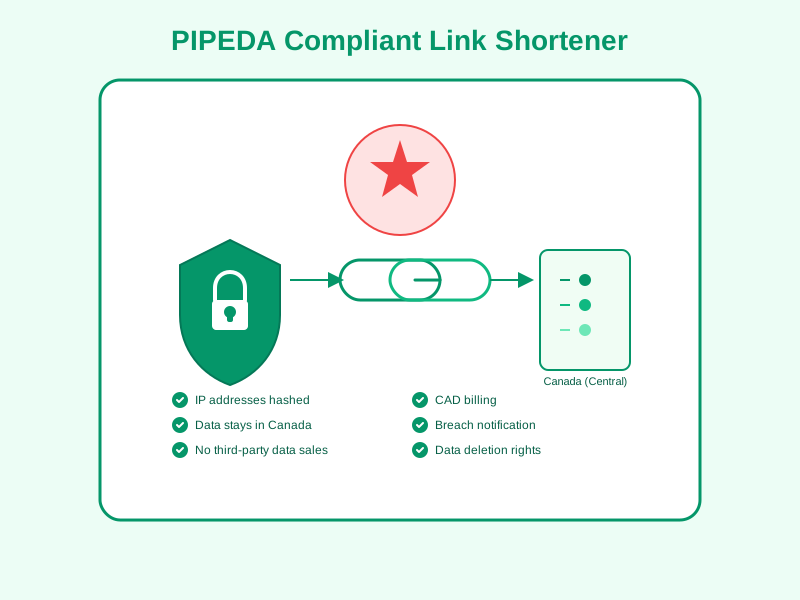
Canadian-hosted infrastructure: Mobily operates on AWS infrastructure in the Canada (Central) region, meaning click data never leaves Canadian territory during normal operation.
IP hashing rather than IP storage: Instead of storing raw IP addresses, Mobily hashes them before writing to the database. This allows geographic analytics (province-level, not street-level) without retaining the personal information itself. A hashed IP cannot be reverse-engineered to identify an individual.
No third-party data sales: Mobily does not sell, license, or share click data with advertising networks, data brokers, or analytics resellers. Your click data belongs to your account only.
CAD pricing with no currency conversion surprises: A minor but relevant point — billing in Canadian dollars means your contract is governed by Canadian commercial law, not a US court clause buried in terms of service.
You can check any shortened URL for safety before clicking, which is part of Mobily's broader commitment to transparent link handling.
The Business Case Beyond Compliance
PIPEDA compliance is the floor, not the ceiling. There are practical business reasons — beyond legal obligation — to choose a Canadian-hosted shortener.
Customer trust is one. Canadians are increasingly aware of where their data goes. A privacy-first link shortener lets you honestly answer "where does click data go?" with "Canada" rather than "our US vendor's servers, subject to their terms."
Procurement is another. If you sell to federal or provincial government clients, or to regulated industries like banking, insurance, or healthcare, data residency requirements in those contracts may disqualify US-hosted vendors outright. Having a Canadian-hosted link shortener removes a procurement objection before it arises.
PIPEDA Compliance Checklist for Link Shorteners
Use this checklist when evaluating any link shortener for use in your Canadian business:
- Data residency: Where are servers physically located? Is Canadian-region hosting explicitly confirmed, not just "available"?
- IP handling: Are raw IP addresses stored, or are they hashed or anonymized before storage?
- Third-party data sharing: Does the vendor share or sell click data to third parties? Review the privacy policy and data processing agreement, not just the marketing page.
- Data processing agreement: Can the vendor provide a DPA that satisfies PIPEDA's accountability requirement for third-party processors?
- Breach notification: What is the vendor's breach notification procedure? PIPEDA requires notification of breaches that create a real risk of significant harm.
- Data deletion: Can you delete all click data associated with your account? Is there a retention limit?
- Consent disclosure: Does your own privacy policy accurately describe that a third-party link shortener collects click data on your behalf?
Getting Started
Switching link shorteners is straightforward. Existing long URLs can be re-shortened, and most platforms let you export your link library. The compliance benefit is immediate from your first link.
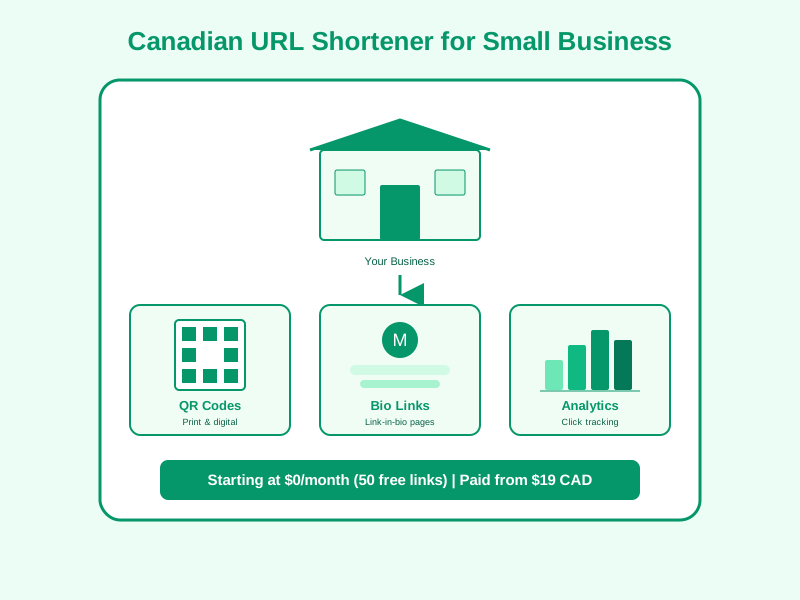
Mobily offers a free plan with 50 links — enough to evaluate the platform for a real campaign before committing. Paid plans start at $19 CAD per month and include advanced analytics, custom domains, QR codes, and bio link pages.
If your organization handles personal information and you are currently using a US-hosted link shortener, the question is not whether PIPEDA applies. The question is whether your current vendor's data practices can withstand scrutiny if the Office of the Privacy Commissioner asks.
A Canadian-hosted, privacy-first shortener is not a premium feature. For Canadian businesses, it is the baseline expectation. See our full pricing and feature comparison to find the right plan for your team.
Ready for PIPEDA-Compliant Link Tracking?
Start with 50 free links. Canadian-hosted. No credit card required.
Start Free